
We are calling on the UK government to add single parents as a protected characteristic to the Equality Act, 2010 to outlaw single parent discrimination.
The Single Parent Rights' campaign
The Single Parent Rights campaign was established by single parents in lockdown 2020 when the fast-paced policy making environment highlighted how overlooked single parents are by policy makers and businesses. Our first campaign success came when we successfully lobbied number ten to introduce support bubbles during that period.
However, being unseen wasn’t new to most single parents and many have faced discrimination in various areas for decades. Our research in early 2021 highlighted just how widespread this discrimination is, with up to 80% of single parent experiencing some form of discrimination. Since then we have gone on to conduct research into multiple areas of single parent discrimination including employment, housing and Universal Credit.
Why is policy change needed?
Single parents face discrimination throughout their daily lives, from the workplace to accessing housing. This has knock-on effects for them, their children and society as a whole.
The Equality Act, 2010 outlaws discrimination towards certain groups who are deemed to have ‘protected characteristics’. Currently, there are nine protected characteristics: age, disability, gender reassignment, marriage and civil partnership, pregnancy and maternity, race, religion or belief, sex, and sexual orientation. Although a natural corollary to many of the current protected characteristics, single parenthood is not included which means despite the challenges single parents face - invariably through no fault of their own - employers, businesses and policy-makers aren’t encouraged to proactively consider how they treat single parents, and where unfair treatment occurs, it cannot be legally challenged.
Many single parents face multiple discrimination, given that 85% are women, around 27% live with a disability (compared with 21% of couple parent households), and black and mixed ethnicity communities have higher numbers of single parents compared with white communities.
You can learn more about the legal background to the campaign here.
benefits from the policy change?
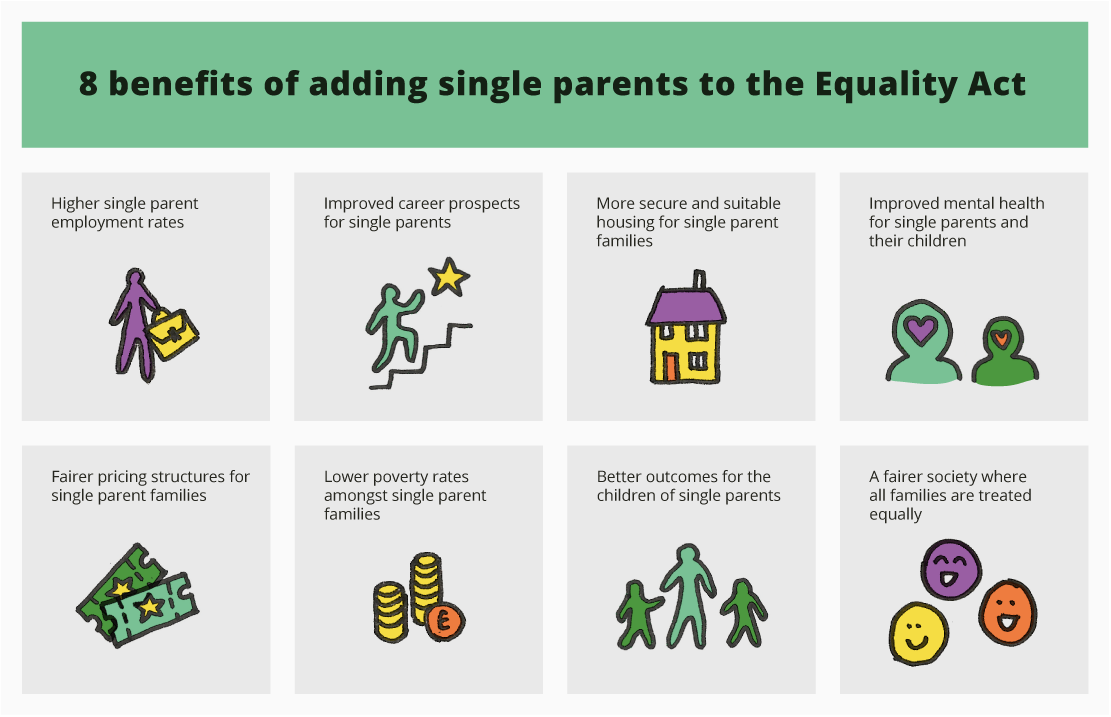
Protecting single parents from discrimination would have a number of benefits for single parent families and wider society.
Greater single parent employment for those applying for roles;
Better working conditions, professional support and career development for those in employment;
Reduced reliance on benefits;
Greater disposable income for single parents to spend in society;
More stable and decent housing for single parent families;
Better mental health for single parents;
Lower poverty levels for children of single parents; and
Better outcomes for the children of single parents.
What discrimination do single parents face?
In the workplace when it comes to recruitment, professional development and promotion;
In housing, specifically accessing private rental properties, especially for those who rely on housing benefit;
In childcare funding, the 30 hours funded childcare is not available to single parent registered carers who are not working, whilst those with a partner in work can access it;
In the benefit cap calculations: a single parent must earn the same as a couple to avoid being capped, even when they are on maternity leave;
In child benefit calculations: a couple can earn up to £160,000 before losing their full entitlement, while a single parent on £80,000 will receive no child benefit;
In childcare vouchers systems, with couples able to access double the amount of vouchers of single parents where both are working, regardless of the actual amount they spend on childcare;
In support and adaptations required for a disabled child to live safely in both homes where care is shared, see Pete’s story in Single Parents Campaigning for Change;
Entrance fees at tourist attractions are often higher per person for single parent families than couple families. At the National Trust single parents pay 25% more per adult compared with a couple family;
Membership fees, e.g. for birthing/parenting classes, are often the same for single parents as for a couple under the claim that the second parent is ‘free’;
In inheritance tax, a child(ren) of a couple in effect has double the threshold compared to the child(ren) of a single parent;
In the costs of holidays; and
In government and business policies and rules during the Coronavirus lockdown 2020.
How to Address SINGLE PARENT DISCRIMINATION
Working with single parents, our campaign supporters, and other organisations, we have identified a three-pronged approach to tackle single parent discrimination. This aims to address the lack of legal protections single parents face, the high levels of stigma they face, and the discriminatory policies and practices they experience. These policy asks are explained in more detail in our research report.
1. Add single parents as a protected characteristic to the Equality Act
2. Address the prejudice and stigma towards single parent families, specifically:
Broaden the definition of ‘family’ to reflect modern Britain and incorporate single parent families
Promote positive narratives of single parent families within the media
Train family/ child related professionals in single parent inclusive policies and practices
Identify more inclusive methods to collect data on the number of single parents in the UK (e.g., counting sole carers, majority carers, fifty-fifty carers, minority carers etc)
3. Tackle sector specific single parent discrimination as outlined below:
Fees and Charges: Create inclusive products and fees for single parent families, specifically:
Offer single parent family tickets for products, services and fees
Ensure products and promotional materials reflect single parent families
Employment: Create flexible employment and affordable childcare for single parents, specifically:
Make flexible working the default for all jobs
Make it mandatory for employers to publish flexible working options for all roles
Make it mandatory for employees to be allowed to request flexible working at any point
Encourage employers to enact single parent inclusive HR policies
Ensure appropriate, flexible, cost-effective childcare is available for single parent families
Increase the national minimum wage to be in line with the living wage
Ensure single parents have equal access to finances, specifically:
Grant the Financial Conduct Authority (FCA) statutory authority to monitor and address lenders’ financial inclusion policies and practices, including single parent borrower
Government benefits, CMS, pensions and taxes: Ensure the system supports single parent families, specifically:
Increase the Universal Credit standard allowance for single parents
Remove the benefit cap
Create a household, not individual, limit for child benefit and funded childcare support
Reduce the Universal Credit taper rate to 50p
Provide thirty hours of funded childcare for 3– to 4-year-olds of single parents who are registered-carers, or disabled
Amend inheritance tax calculations so all families benefit from the same tax-free inheritance levels
Increase the council tax reduction to 50% for single parents and fund it through central government
Remove the £10,000 earning limit for auto-enrolment in workplace pensions
Ensure the Child Maintenance Service is fit for purpose and protects the rights of the child
Housing: Ensure the housing sector protects single parents, specifically:
Add single parents as a group protected from discrimination by the Renters Rights Act
Waive the bedroom tax for Non-Resident Parents with overnight care of their children
How can I get involved?
Join others across the UK and take action for single parent families today.

For more information on the campaign, you can also download one of our campaign briefings below or learn more about the legal background to the campaign here.
If you represent an organisation (schools, businesses and employers) that wants to become more single parent inclusive, go to our resources page to download our free resources.